
Monday, 5 April 2010

Initial Designs Evaluation - Rajinder Sidhu
The purpose of this 5x5 design evealuator is to review designs according to a set of criteria. The result is a perfection rating where 100% is perfect and 0% is useless. Scores of 80% or higher indicate the design is very good and worth taking further.
A rating of 0 indicates the design does not meet that criterion in any way. A rating of 5 indicates the design perfectly meets that criterion.
By multiplying the total number of points each design recieves by four gives us a score out of 100 possible points.

From the evaluation we can see that designs 1 and 2 are the most feasible. Aspects of these designs will definitely be taken further. Also, some aspects of the other lesser feasible designs will be looked at and analysed further in the next stage of development.
A rating of 0 indicates the design does not meet that criterion in any way. A rating of 5 indicates the design perfectly meets that criterion.
By multiplying the total number of points each design recieves by four gives us a score out of 100 possible points.

From the evaluation we can see that designs 1 and 2 are the most feasible. Aspects of these designs will definitely be taken further. Also, some aspects of the other lesser feasible designs will be looked at and analysed further in the next stage of development.


Sunday, 4 April 2010

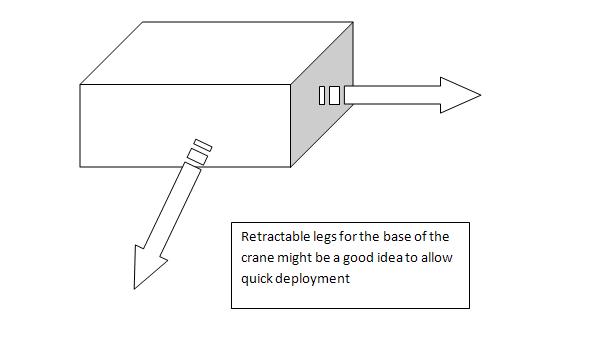


Initial Designs (ii) - Rohit Shukla

Designed with the following in mind –
Portable
· The whole crane can be disassembled to two main pieces (Arm and Base), the other parts (Winch, Pully and hook system) can be carried in separately and easily stored.
· The arm is designed to fold out using a pivoting position and can be folded away into a ‘resting position’ for easy storage and transport.
· Retractable Legs allow for stability, but most of all do not get in the way when transporting the equipment around.
Safety
· The entire system is manually operated, using no hydraulics or electrical parts; this ensures that there is no danger in using it near a disaster zone that has potentially explosive or flammable leaked material nearby.
· The winching system is UL approved for the movement and transport of humans, which could be essential when deployed in earthquake relief areas.
· Locking arm means no danger of it becoming unstable.
Ease and Speed of Use
· With only two main parts to put together, it can be easily and more importantly quickly put together.
· The winching system is easy to set up and requires virtually no effort to pull a tonnes worth of rubble.
· The entire system could be operated by one person.
· Easy to maintain as there is no extra generator or electrical systems to worry about.

Saturday, 3 April 2010


Crisis Area Research
Follwing natural disasters, such as those seen recently in Haiti and Chile, transport is severely affected. As a result securing links to crisis areas are virtually impossible.
The Haiti earthquake has destoyed the capital's port, meaning no access to the affected areas can be made by the use of ships. This has followed on to the airport being seized-up because of the increased amount of air traffic. Rail lines have also been affected by the earthquake and made them unsafe for use.
Also, transporting cranes and other heavy lifting equipment to the affected areas is very difficult becasue of the uneven terrain. The only feasible way of reaching the crisis areas to deliver the cranes and lifting equipment are by using 4x4 vehicles or small helicopters.
It can be seen in the image below how the earthquake has affected the city. It shows that some roads have been closed and most roads have restricted access.
 The image below shows that most of the affected building only have a ground floor.This means the crane we are to design does not need to exceed the height of a two storey building.
The Haiti earthquake has destoyed the capital's port, meaning no access to the affected areas can be made by the use of ships. This has followed on to the airport being seized-up because of the increased amount of air traffic. Rail lines have also been affected by the earthquake and made them unsafe for use.
Also, transporting cranes and other heavy lifting equipment to the affected areas is very difficult becasue of the uneven terrain. The only feasible way of reaching the crisis areas to deliver the cranes and lifting equipment are by using 4x4 vehicles or small helicopters.
It can be seen in the image below how the earthquake has affected the city. It shows that some roads have been closed and most roads have restricted access.
 The image below shows that most of the affected building only have a ground floor.This means the crane we are to design does not need to exceed the height of a two storey building.


Image source: BBC News, The scale of the devastation is huge with much of the capital of Haiti flattened, http://news.bbc.co.uk/1/shared/spl/hi/pop_ups/08/americas_enl_1263474705/html/1.stm , Accessed 3rd April 2010.
Subscribe to:
Posts (Atom)